

Infertility is becoming increasingly common in India due to delayed parenthood, lifestyle changes, stress, PCOS, endometriosis, male fertility issues, and environmental factors. As a result, modern fertility treatments are rapidly evolving, with IVF laboratories now adopting advanced technologies to improve embryo selection and treatment precision.
One such innovation gaining major attention in 2026 is Time-Lapse Embryo Monitoring (TLM), a sophisticated imaging system that allows embryologists to continuously observe embryo development without disturbing the culture environment.
But does this technology truly improve IVF success rates? And how relevant is it for Indian couples seeking fertility treatment at advanced centers like ARTBaby?
This detailed guide explains how time-lapse embryo monitoring works, its benefits, limitations, and what Indian patients should realistically expect from this evolving IVF technology.
What Is Time-Lapse Embryo Monitoring?
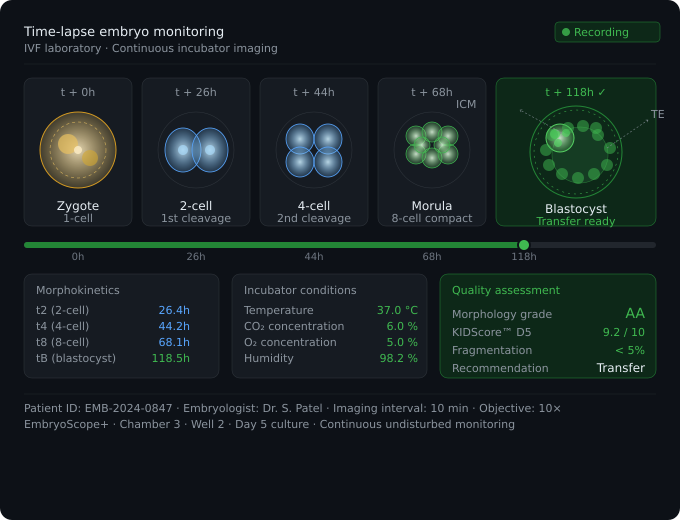
Time-lapse embryo monitoring is an advanced IVF laboratory technology that continuously captures images of embryos inside a specialized incubator.
Unlike traditional embryo assessment where embryos are periodically removed from the incubator for microscopic evaluation time-lapse systems allow embryos to remain in a stable environment while their development is recorded 24/7.
The technology creates a detailed developmental “movie” of each embryo from fertilization to blastocyst stage.
This helps embryologists observe:
- Cell division timing
- Embryo growth patterns
- Morphological changes
- Developmental abnormalities
- Early indicators of implantation potential
In modern IVF practice, time-lapse systems are becoming increasingly important for data-driven embryo selection.
How Does Time-Lapse Monitoring Work in IVF?
Specialized incubators equipped with built-in cameras take images of embryos every few minutes.
These images are then analyzed by embryologists to assess:
- Fertilization quality
- Cleavage patterns
- Embryo symmetry
- Cell division timing
- Blastocyst development
Because embryos remain undisturbed inside controlled incubators, the laboratory environment becomes more stable.
This may reduce exposure to:
- Temperature fluctuations
- pH changes
- Light exposure
- External handling stress
Such stability is considered beneficial for embryo development.
Why Traditional Embryo Assessment Has Limitations?
Conventional IVF embryo grading depends on observing embryos once or twice daily under a microscope.
However, this method has limitations:
- Important developmental events may be missed
- Embryos are temporarily removed from incubators
- Assessment depends heavily on visual morphology alone
- Some embryos may appear normal but develop abnormally later
Time-lapse technology attempts to solve these gaps by providing continuous developmental tracking.
Does Time-Lapse Monitoring Improve IVF Success Rates?
This remains one of the most discussed topics in reproductive medicine.
Several studies suggest that time-lapse monitoring may help improve embryo selection efficiency, especially in advanced IVF laboratories. However, researchers also note that outcomes depend on multiple factors, including maternal age, embryo quality, ovarian reserve, sperm health, and laboratory expertise.
Recent research published in major reproductive medicine journals suggests that time-lapse systems may offer benefits in:
- Blastocyst selection
- Implantation prediction
- Reduction of embryo handling
- Identification of abnormal cleavage patterns
- Single embryo transfer planning
Some fertility centers report improved clinical pregnancy and implantation rates when time-lapse monitoring is combined with expert embryology practices. However, evidence regarding significantly higher live birth rates remains mixed across studies.
This means time-lapse monitoring should be viewed as a supportive IVF tool—not a guaranteed success enhancer.
Key Advantages of Time-Lapse Embryo Monitoring
1. Continuous Embryo Observation
Embryologists can monitor embryo development at every stage without interruption.
This helps identify subtle developmental changes that may not be visible during routine checks.
2. Stable Embryo Culture Environment
Embryos remain inside incubators throughout development.
Reduced handling may help maintain optimal:
- Temperature
- Humidity
- Gas concentration
- pH balance
Stable conditions are critical for embryo viability.
3. Better Embryo Selection
Time-lapse systems provide additional developmental information beyond standard morphology.
This can help embryologists prioritize embryos with healthier developmental patterns.
4. Supports Single Embryo Transfer
Improved embryo selection may support safer single embryo transfer strategies.
This reduces the risk of:
- Multiple pregnancy
- Premature birth
- Pregnancy complications
Single embryo transfer is becoming increasingly important in modern IVF care.
5. Helpful for Complex IVF Cases
Time-lapse monitoring may be particularly useful in patients with:
- Recurrent IVF failure
- Advanced maternal age
- Poor embryo quality
- Recurrent miscarriage
- Male factor infertility
What Embryologists Look for During Time-Lapse Monitoring
Time-lapse systems allow specialists to analyze several embryo development markers, including:
- Timing of first cell division
- Synchronization of cell divisions
- Fragmentation patterns
- Blastocyst expansion
- Development speed
- Abnormal cleavage behavior
Some IVF laboratories combine these observations with advanced data analytics to improve embryo ranking systems.
The Growing Role of Data-Driven IVF in India
India’s IVF industry is evolving rapidly in 2026.
Advanced fertility centers are now integrating:
- Time-lapse incubators
- Digital embryo scoring
- Electronic lab tracking
- Data-driven embryo assessment
- Improved culture systems
This reflects a broader shift toward precision fertility care.
Urban fertility centers are increasingly adopting technologies that combine embryologist expertise with laboratory analytics to improve treatment planning and patient outcomes.
At modern IVF clinics like ARTBaby IVF Center individualized fertility care focuses not only on advanced technology but also on patient-specific reproductive factors.
Is Time-Lapse Monitoring Recommended for Every IVF Patient?
Not necessarily.
The decision depends on several factors:
- Age of the woman
- Embryo quality
- IVF history
- Number of embryos available
- Risk factors
- Budget considerations
For some patients, standard IVF culture methods may still provide excellent outcomes.
An experienced fertility specialist can help determine whether time-lapse monitoring adds meaningful value to a particular IVF cycle.
Are There Any Limitations?
Although promising, time-lapse monitoring is not a miracle solution.
Important limitations include:
1. Increased Treatment Cost
Advanced incubator systems may increase IVF expenses.
2. Technology Cannot Replace Embryologist Expertise
Successful IVF still depends heavily on:
- Lab quality
- Embryologist skill
- Clinical protocols
- Individual patient biology
3. Mixed Evidence on Live Birth Improvement
While embryo selection may improve, studies continue to evaluate whether the technology consistently increases live birth rates across all patient groups.
Time-Lapse Monitoring and Frozen Embryo Transfer (FET)
Time-lapse assessment may also support better embryo freezing decisions.
High-quality embryos identified through developmental tracking can be selected for:
- Fresh transfer
- Frozen embryo transfer
- Future fertility preservation
With frozen embryo transfer becoming increasingly common in India, advanced embryo assessment tools are gaining greater clinical relevance.
Future of Embryo Monitoring in IVF
The future of IVF is becoming increasingly personalized and technology-driven.
Emerging innovations may soon combine:
- Time-lapse imaging
- Non-invasive embryo assessment
- Genetic screening
- Metabolomic analysis
- Predictive reproductive analytics
The goal is to improve embryo selection while reducing invasive procedures and emotional stress for couples.
India’s fertility sector is expected to continue adopting these innovations as IVF demand expands across metropolitan and Tier II cities.
What Indian Couples Should Know Before Choosing Advanced IVF Technologies
Before selecting advanced IVF add-ons, patients should ask:
- Is the technology evidence-based?
- Will it improve outcomes in my case?
- What are the additional costs?
- Does the clinic have experienced embryologists?
- Is the laboratory well-equipped and standardized?
Technology works best when combined with ethical care, transparent counseling, and individualized treatment planning.
Final Thoughts
Time-lapse embryo monitoring represents an important advancement in modern IVF laboratory science. By allowing continuous embryo observation in a stable environment, it offers embryologists deeper insights into embryo development and may support more informed embryo selection.
However, IVF success still depends on multiple factors—including age, egg quality, sperm health, uterine conditions, laboratory standards, and overall clinical expertise.
For Indian couples exploring fertility treatment in 2026, understanding the role of technologies like time-lapse monitoring can help them make more informed and confident decisions.
At ARTBaby IVF Center, modern fertility care combines advanced reproductive technologies with individualized treatment approaches designed to support safer, evidence-based, and patient-centered IVF journeys.
Disclaimer:
This blog is intended for educational purposes only and should not be considered medical advice. Fertility treatment outcomes vary from person to person. Patients should consult qualified fertility specialists for individualized diagnosis and treatment recommendations.
