
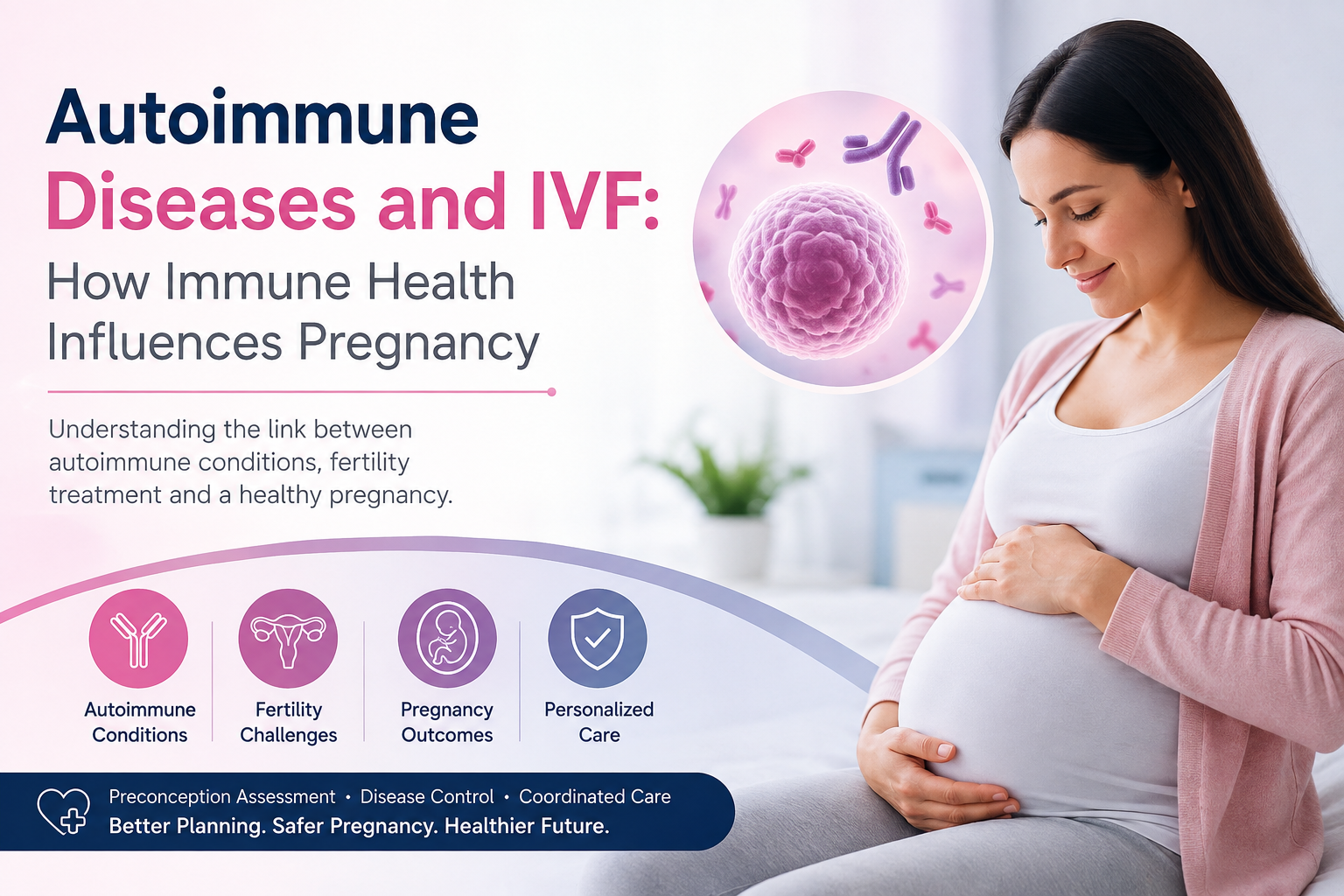
For many people planning IVF, the focus naturally falls on ovarian reserve, sperm quality, embryos and the uterus. But for some patients, another part of the picture deserves careful attention: the immune system.
Autoimmune diseases occur when the immune system mistakenly attacks the body’s own tissues. Conditions such as systemic lupus erythematosus (SLE), antiphospholipid syndrome (APS), rheumatoid arthritis, autoimmune thyroid disease and some other inflammatory disorders can influence fertility, pregnancy planning or pregnancy outcomes.
Importantly, having an autoimmune disease does not automatically mean that IVF will fail or that a healthy pregnancy is impossible. With appropriate preconception assessment, disease control and coordinated medical care, many patients can pursue fertility treatment safely.
For patients considering IVF in India, understanding when immune health matters and when it does not is essential.
How Can Autoimmune Diseases Affect Fertility and Pregnancy?
The relationship between autoimmune disease and fertility is complex. The impact depends on the specific condition, its severity, medications being used, and whether important organs are involved.
Some autoimmune or inflammatory diseases may affect:
- Ovulation or ovarian function
- Menstrual cycles
- The uterine environment
- Implantation and placental development
- Blood-clotting risk
- Pregnancy-related complications
- The safety of certain fertility or pregnancy medications
In some patients, fertility may also be affected indirectly. For example, treatment with certain gonadotoxic medicines can reduce ovarian reserve. This makes fertility preservation before treatment an important consideration for some women with autoimmune disease.
The American College of Rheumatology recommends reproductive planning for patients with rheumatic diseases and emphasizes entering pregnancy when disease activity is low or stable whenever possible.
Autoimmune Conditions That May Require Special Attention
- Systemic Lupus Erythematosus (SLE)
Lupus can affect multiple organs and may become more difficult to manage during pregnancy in some patients.
Before IVF or pregnancy, doctors may assess disease activity, kidney function, blood pressure, and relevant antibodies. Medication safety is equally important because some medicines used to control autoimmune disease are unsuitable during pregnancy.
The goal is not simply to achieve pregnancy, but to begin pregnancy when the patient’s health is in the safest possible condition.
- Antiphospholipid Syndrome (APS)
APS deserves particular attention in fertility and pregnancy care.
It is an autoimmune condition associated with abnormal blood clotting and certain pregnancy complications, including recurrent pregnancy loss. Diagnosis requires both appropriate clinical features and persistent antiphospholipid antibodies, not simply a single positive blood test.
Relevant laboratory testing can include:
- Lupus anticoagulant
- Anticardiolipin IgG/IgM
- Anti-beta-2 glycoprotein I IgG/IgM
Current American Society for Reproductive Medicine (ASRM) guidance recommends antiphospholipid antibody evaluation when patients meet appropriate clinical criteria. Confirmed APS may require individualized antithrombotic management during pregnancy.
Patients should not start aspirin or blood thinners on their own. The decision depends on the diagnosis, medical history, and risk of bleeding or thrombosis.
- Autoimmune Thyroid Disease
Thyroid disorders are relatively common among women of reproductive age.
Conditions such as Hashimoto’s thyroiditis can be associated with hypothyroidism. While the presence of thyroid antibodies alone does not mean that IVF will fail, untreated or inadequately controlled thyroid dysfunction can affect reproductive and pregnancy outcomes.
This is why thyroid function is often assessed as part of fertility and preconception care when clinically indicated.
- Rheumatoid Arthritis and Other Inflammatory Diseases
Rheumatoid arthritis and other systemic inflammatory conditions do not necessarily prevent IVF.
However, disease activity, medications and associated health problems should be reviewed before treatment. Some medicines may need to be stopped, substituted or adjusted before conception.
The timing of IVF therefore becomes part of the overall medical plan rather than a decision based only on reproductive factors.
Why Immune Health Matters During Pregnancy
Pregnancy requires a highly coordinated interaction between the maternal immune system, placenta, and developing embryo.
The immune system does not simply need to be “strong.” Instead, it needs to maintain an appropriate balance that allows the pregnancy to develop while continuing to protect the mother from infections.
This is an important distinction for IVF patients – A healthy pregnancy does not depend on having an “overactive” or “boosted” immune system.
Autoimmune disease can create additional challenges because abnormal immune activity, inflammation, or blood-clotting mechanisms may contribute to complications in selected patients.
However, the relationship between immune markers and IVF outcomes is complicated, and not every abnormal laboratory result represents a treatable fertility problem.
What Should an IVF Patient With Autoimmune Disease Expect?
A personalized evaluation may include several components.
- Detailed medical history
The fertility specialist may review:
- Autoimmune diagnosis and duration
- Previous pregnancies and miscarriages
- Previous IVF cycles
- Current medications
- Previous blood clots
- Kidney, liver or other organ involvement
- Disease flares
- Family history
- Previous pregnancy complications
- Disease activity assessment
For conditions such as lupus or rheumatoid arthritis, controlling active disease before conception is an important part of reproductive planning.
The ACR recommends counseling patients with rheumatic disease about the improved maternal and fetal outcomes associated with entering pregnancy during periods of low disease activity.
- Medication review
This is particularly important.
Some autoimmune medicines are compatible with pregnancy, while others may pose risks to the developing fetus. Medication changes should therefore be planned before IVF or conception, rather than after pregnancy is established.
Patients should never discontinue prescribed autoimmune medication without consulting the treating specialist.
- Targeted testing
Testing should be based on the patient’s history and clinical findings.
For example, a patient with recurrent pregnancy loss and clinical features suggestive of APS may require antiphospholipid antibody testing.
In contrast, ordering a large panel of immune tests for every IVF patient is not supported by current evidence.
What About NK Cells, Immune Panels and IVF “Immune Treatments”?
This is an area where patients need particularly clear information.
Commercial fertility testing sometimes promotes investigations such as natural killer (NK) cell testing or broad immune panels, followed by treatments intended to “correct” the immune system.
However, the evidence remains limited.
The 2026 ASRM guidance on recurrent pregnancy loss does not recommend routine immune testing or treatment. Similarly, its 2026 guidance on recurrent implantation failure states that there is insufficient evidence to support routine immunologic therapies such as IVIG, G-CSF or anticoagulation in patients without an appropriate indication.
Earlier ASRM guidance also concluded that immunological testing cannot routinely be recommended for the general ART population because the relationship between immune profiles and IVF outcomes has not been sufficiently established.
This does not mean that immune factors are irrelevant. It means that testing and treatment should be clinically justified rather than automatically added to an IVF package.
Evidence-Based IVF Care for Patients With Autoimmune Disease in India
For an Indian patient with an autoimmune condition, an effective fertility plan may involve collaboration between:
- Reproductive medicine/fertility specialist to plan ovarian stimulation, embryo creation and transfer.
- Rheumatologist or relevant specialist to assess disease activity and medication safety.
- Maternal-fetal medicine or high-risk obstetric specialist, when indicated, particularly for patients with significant systemic disease or pregnancy-risk factors.
- Hematologist, when clinically appropriate, especially for patients with confirmed APS or significant thrombotic history.
This multidisciplinary approach can be particularly valuable when IVF is being planned after recurrent pregnancy loss, previous implantation failure, or a serious autoimmune diagnosis.
Can IVF Be Successful With an Autoimmune Disease?
Yes, it can.
An autoimmune diagnosis should not automatically be interpreted as a poor IVF prognosis.
The outcome depends on multiple factors, including:
- Maternal age
- Ovarian reserve and response to stimulation
- Egg and sperm quality
- Embryo development
- Chromosomal status where testing is clinically appropriate
- Uterine health
- Underlying autoimmune disease
- Disease activity
- Medication safety
- Previous pregnancy history
- Other medical conditions
For patients with recurrent pregnancy loss, current evidence also emphasizes looking for established causes rather than assuming that an unexplained miscarriage is necessarily an “immune rejection” of the embryo. ASRM’s 2026 guidance recommends a structured evaluation that can include chromosome assessment, uterine evaluation and targeted APS testing when clinically indicated.
How ARTBaby Approaches Patient-Centred Fertility Care
For patients seeking IVF in India, the objective should be more than simply completing an IVF cycle.
At ARTBaby, patients with complex reproductive histories can benefit from an individualized approach in which their fertility history, medical conditions and treatment goals are considered together.
If you have an autoimmune disease, tell your fertility specialist about your diagnosis and provide details of all current and previous medications, previous pregnancies, miscarriages, blood-clotting problems and specialist reports.
This information can help the clinical team determine whether additional evaluation or specialist coordination is appropriate.
Questions to Ask Your Fertility Specialist
Before beginning IVF, consider asking:
- Is my autoimmune disease currently stable enough for IVF?
- Do I need clearance from my rheumatologist or another specialist?
- Are my current medications compatible with pregnancy?
- Do I have clinical indications for antiphospholipid antibody testing?
- Could my autoimmune condition or treatment affect ovarian reserve?
- Do I have any additional pregnancy or clotting risks?
- Which tests are genuinely necessary in my situation?
- Are proposed immune treatments supported by good-quality evidence?
The Bottom Line
Autoimmune disease and IVF can coexist, but successful fertility care requires individualized medical planning rather than a one-size-fits-all “immune treatment.”
For some patients, conditions such as lupus or APS require careful disease control, medication review, and specialist monitoring. For others, extensive immune testing may provide little useful information and could lead to unnecessary treatment.
The most important principle is simple: identify genuine medical risks, treat established conditions appropriately, and avoid interventions that lack convincing evidence.
For patients in India considering IVF, an experienced fertility team working alongside the appropriate medical specialists can help turn a complex medical history into a carefully planned fertility journey.
References:
- https://pmc.ncbi.nlm.nih.gov/articles/PMC5831976/
Disclaimer
This article is intended for general educational purposes and should not be considered medical advice, diagnosis or a substitute for consultation with a qualified fertility specialist, rheumatologist or obstetrician. Autoimmune diseases and their treatments vary considerably between patients. IVF protocols, investigations and medications should be recommended only after an individual medical assessment.
