
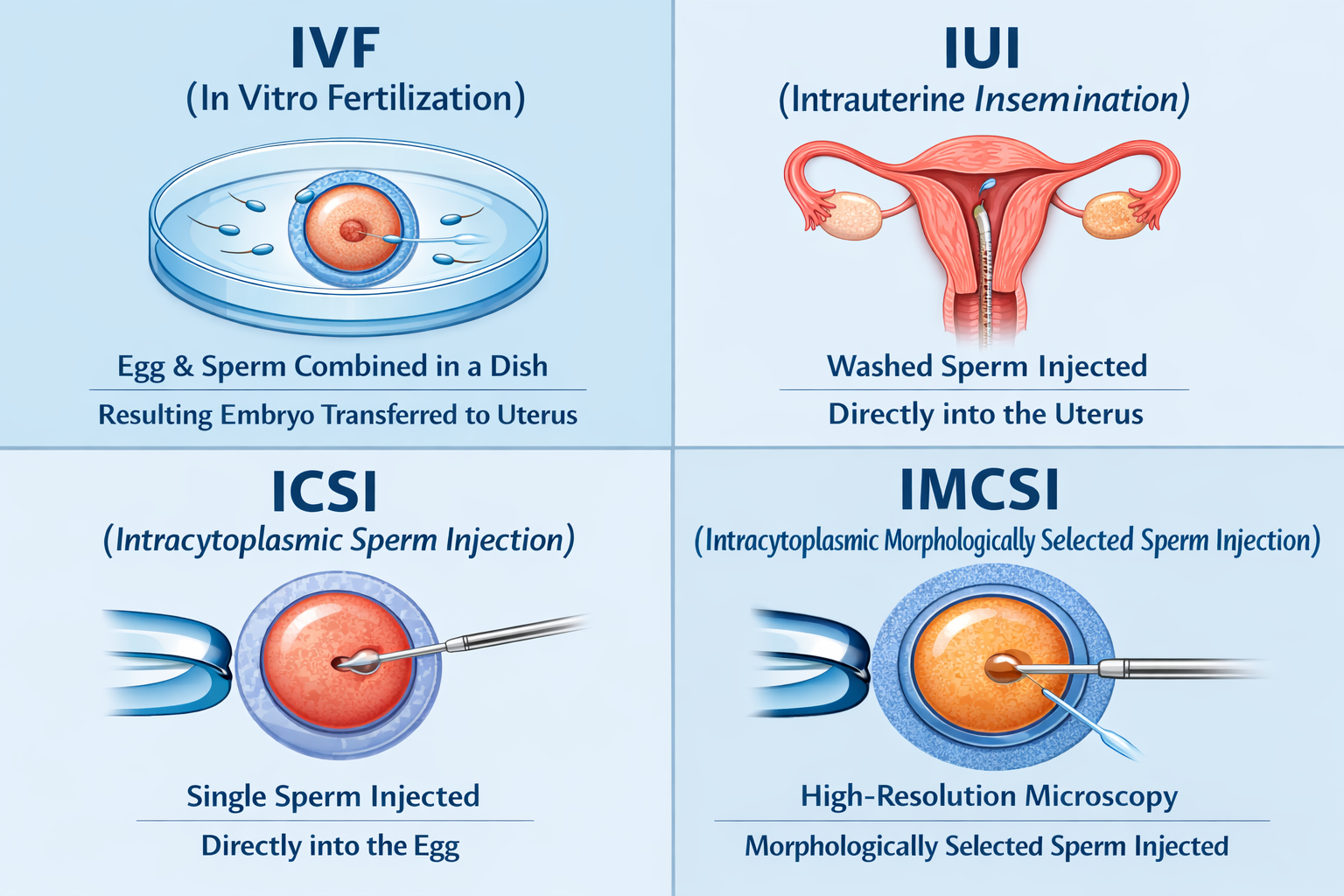
Infertility can feel overwhelming, but modern Assisted Reproductive Technologies (ART) have made parenthood possible for millions of individuals and couples worldwide. Understanding the difference between IUI, IVF, ICSI, and IMSI is essential to choosing the right fertility treatment and improving the chances of success.
This guide explains each procedure clearly, highlights what it is best suited for, and helps you make informed decisions with confidence.
What Are Assisted Reproductive Technologies (ART)?
Assisted Reproductive Technologies (ART) is medical procedures designed to help achieve pregnancy when natural conception is difficult or impossible.
ART primarily involves:
- Handling eggs and sperm outside the body
- Fertilization under controlled laboratory conditions
- Transferring embryos into the uterus
The most commonly used ART methods include:
- IUI (Intrauterine Insemination)
- IVF (In Vitro Fertilization)
- ICSI (Intracytoplasmic Sperm Injection)
- IMSI (Intracytoplasmic Morphologically Selected Sperm Injection)
Each technique has a specific purpose and is chosen based on medical findings—not preference alone.
What Is IUI (Intrauterine Insemination)?
IUI is often the first-line fertility treatment because it is simple, minimally invasive, and affordable.
How IUI Works
- Ovulation is monitored naturally or with mild medication
- A processed semen sample is prepared in the lab
- Healthy sperm are placed directly into the uterus using a thin catheter
- Fertilization occurs naturally in the fallopian tubes
Who Is IUI Recommended For?
- Mild male infertility
- Ovulation disorders such as PCOS
- Cervical mucus problems
- Unexplained infertility
- Single women or same-sex couples using donor sperm
Doctors usually recommend 3–4 IUI cycles before moving to IVF.
What Is IVF (In Vitro Fertilization)?
IVF is the foundation of modern fertility treatment and is suitable for a wide range of infertility conditions.
IVF Process Explained
- Ovarian stimulationto produce multiple eggs
- Egg retrievalunder short anesthesia
- Fertilization in the labby mixing eggs and sperm
- Embryo culturefor 3–5 days
- Embryo transferinto the uterus
IVF Is Commonly Used For:
- Blocked or damaged fallopian tubes
- Endometriosis
- Advanced maternal age
- Failed IUI cycles
- Unexplained infertility
IVF allows doctors to closely monitor embryo development and optimize implantation timing.
What Is ICSI (Intracytoplasmic Sperm Injection)?
ICSI is a specialized form of IVF designed primarily for male infertility.
How ICSI Differs From IVF?
- Instead of allowing sperm to fertilize the egg naturally
- A single sperm is directly injected into the eggusing micromanipulation tools
ICSI Is Recommended When:
- Sperm count is very low
- Sperm motility is poor
- Sperm morphology is abnormal
- Surgical sperm retrieval is required
- Previous IVF cycles showed poor fertilization
ICSI significantly improves fertilization rates when sperm quality is compromised.
What Is IMSI (Intracytoplasmic Morphologically Selected Sperm Injection)?
IMSI is an advanced refinement of ICSI.
How IMSI Works
- Uses ultra-high magnification microscopy (up to 6000x)
- Allows embryologists to examine sperm structure in extreme detail
- Selects sperm with the best nuclear morphology
Who May Benefit From IMSI?
- Repeated IVF or ICSI failures
- High sperm DNA fragmentation
- Severe sperm morphology defects
- Recurrent pregnancy loss
IMSI adds an extra layer of precision for complex male infertility cases.
Key Differences between IUI, IVF, ICSI & IMSI
| Aspect | IUI | IVF | ICSI | IMSI |
| Fertilization | Inside the body | In lab dish | Direct sperm injection | Advanced sperm selection + injection |
| Invasiveness | Minimal | Moderate | High | High |
| Best For | Mild infertility | Most infertility types | Severe male infertility | Repeated failures |
| Success Rate | 10–20% | 30–50% | 60–80% | Higher in selected cases |
| Cost (India) | ₹5,000–₹10,000 | ₹80,000–₹1.5 lakh | ₹1.5–3 lakh | Higher than ICSI |
| Technology Level | Basic | Advanced | Highly advanced | Ultra-advanced |
Success Rates: What You Should Know
Success rates vary based on:
- Age
- Fertility diagnosis
- Egg and sperm quality
- Clinic expertise
Average Success Rates
- IUI:10–20% per cycle
- IVF:Up to 40% (under age 35)
- ICSI:Higher fertilization rates in male infertility
- IMSI:Improved outcomes in selected complex cases
Your fertility specialist evaluates your personal data, not generic statistics.
IUI vs IVF vs ICSI or IMSI: How to Choose the Right Treatment
Doctors consider several factors:
- Age of both partners
- Cause and duration of infertility
- Previous treatment outcomes
- Time sensitivity
- Budget considerations
General guidance:
- Start with IUIfor mild cases
- Move to IVFif IUI fails or infertility is complex
- Use ICSI or IMSIwhen male factor infertility is present
Pain, Recovery & Safety
- IUI:Mild discomfort, no recovery time
- IVF / ICSI / IMSI:Egg retrieval done under anesthesia; recovery is quick
- Normal activities can usually resume within a day or two
All procedures are considered safe when performed by experienced fertility specialists.
Final Thoughts
IUI, IVF, ICSI, and IMSI are not competing treatments; they are strategic options used at different stages of infertility care. The best treatment is not the most advanced one, but the most appropriate one for your medical condition.
At Artbaby IVF, treatment decisions are guided by:
- Evidence-based medicine
- Individual fertility profiles
- Ethical and transparent care
A detailed consultation with an experienced fertility specialist can help you move forward with clarity, confidence, and hope.
Ref 1: IUI VS IVF
Ref 2: IUI
