
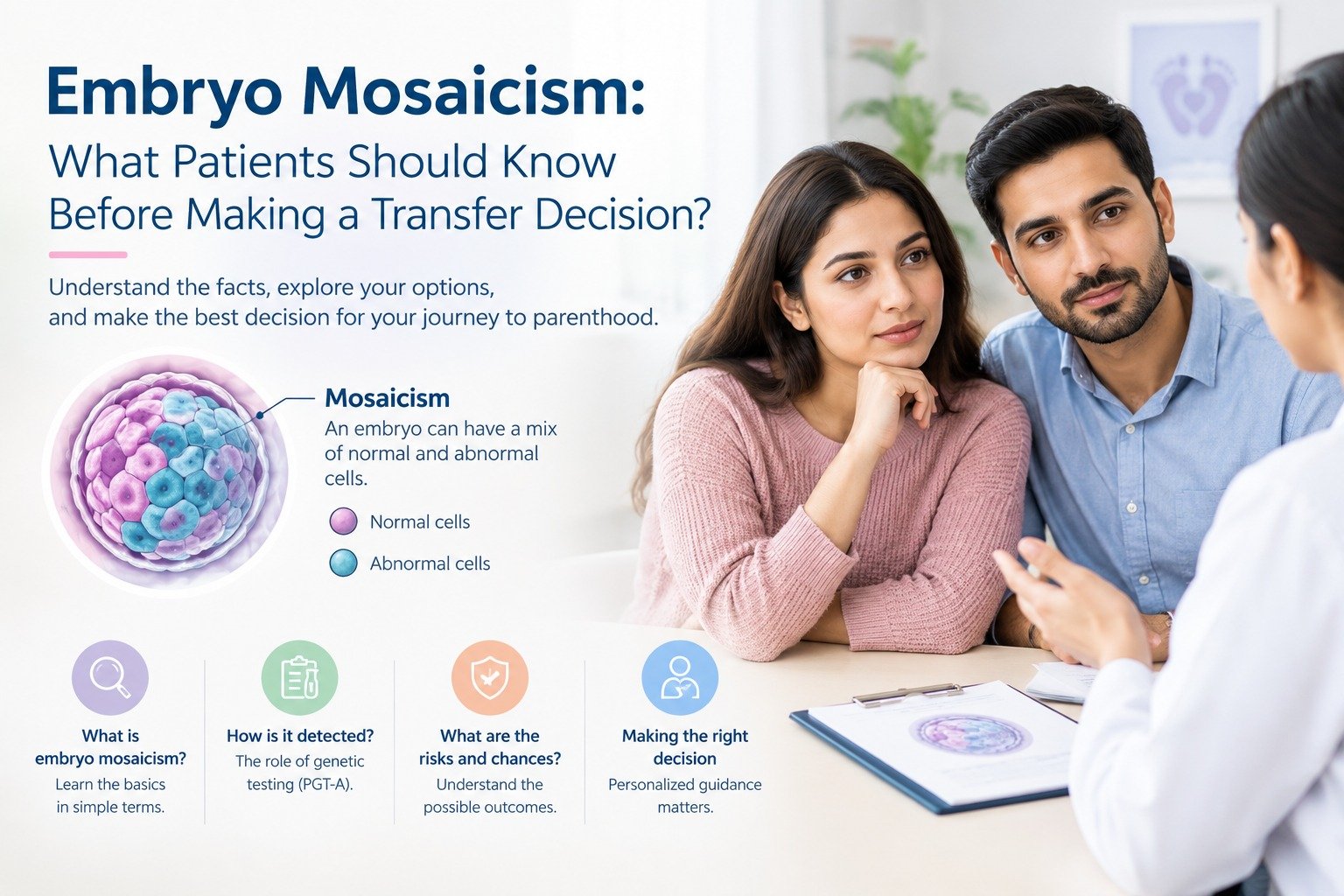
Receiving a “mosaic” result after PGT-A can be confusing and stressful for IVF patients. You may wonder: Is the embryo abnormal? Can it become a healthy baby? Should we transfer it or look for another embryo? The answer is not always straightforward.
Modern genetic testing has made it possible to identify chromosome patterns in embryos that were previously difficult to detect. However, a mosaic PGT-A result does not automatically mean that the entire embryo is abnormal. For international IVF patients, understanding what the result means and what it does not mean is especially important before making a transfer decision.
What Is Embryo Mosaicism?
Embryo mosaicism refers to the presence, or suspected presence, of cells with different chromosome patterns within an embryo.
During PGT-A, a few cells are removed from the trophectoderm, the outer layer of a blastocyst that contributes mainly to the placenta. The inner cell mass, which develops into the fetus, is not directly tested. Therefore, a mosaic result from the biopsy does not necessarily tell us the chromosome status of every cell in the embryo.
ASRM notes that intermediate chromosome-copy results may have several explanations, including true mosaicism, technical variation, amplification bias, contamination and differences in biopsy or laboratory procedures.
Why Does PGT-A Report Mosaic Results?
PGT-A is a laboratory screening that uses genetic testing to assess an embryo for the expected number of chromosomes.
Modern testing methods can identify intermediate or mixed signals in the biopsy sample. Depending on the laboratory’s testing platform and reporting thresholds, these findings may be reported as mosaic or suggestive of mosaicism. This is why two laboratories may not always classify exactly the same genetic finding in the same way.
ESHRE recommends that reports clearly explain the technical and biological limitations of detecting mosaicism.
Does a Mosaic Embryo Mean a Baby Will Have a Chromosomal Condition?
Not necessarily. This is one of the most important points for patients to understand. Mosaic embryos have resulted in ongoing pregnancies and healthy births. At the same time, studies suggest that some mosaic-result embryos may have lower implantation rates and higher miscarriage rates than embryos classified as euploid.
ASRM’s review of available evidence found that the rate of fetal or neonatal confirmation of the same chromosomal abnormality reported in the mosaic PGT-A result was less than 1% in the published data available for its 2023 committee opinion. However, this should not be interpreted as a guarantee of a healthy outcome for an individual pregnancy.
Low-Level and High-Level Mosaicism
You may see terms such as low-level mosaic or high-level mosaic on a PGT-A report. These terms generally describe the proportion of abnormal signal detected in the tested biopsy. However, the percentage should not be interpreted as the percentage of abnormal cells in the entire embryo.
Importantly, ASRM states that there is currently no evidence-based method for predicting an individual embryo’s outcome simply by ranking mosaic embryos according to these characteristics. ESHRE has also highlighted that evidence is insufficient to provide firm recommendations for high-range mosaic embryo transfer.
Can a Mosaic Embryo Be Transferred?
In some circumstances, the answer is yes. The decision depends on the individual PGT-A result, the availability of euploid embryos, embryo morphology, the patient’s reproductive history, and the policies of the fertility clinic.
ESHRE recommends that, when considering embryos with euploid and low-range mosaic results, the PGT-A result should be considered together with embryo morphology rather than used alone.
However, patients should not assume that every mosaic embryo carries the same potential. The chromosome involved and the type of result can influence clinical discussions, but current evidence does not allow doctors to predict the outcome with certainty.
What Are the Main Concerns With Mosaic Embryo Transfer?
Patients should discuss several issues with their fertility specialist and genetic counselor:
- Implantation: Some studies report lower implantation rates than with euploid embryos.
- Miscarriage: Certain mosaic-result embryos have been associated with higher miscarriage rates.
- Chromosomal outcome: A small number of pregnancies have shown chromosomal findings related to the original PGT-A result.
- Testing limitations: The biopsy represents only a small sample of the embryo.
- Uncertainty: Long-term data remain limited compared with euploid embryo transfers.
These uncertainties are why the decision should be individualized rather than based on a single number or label.
What Should International Patients Consider?
For patients travelling across borders for IVF, there is an additional layer of complexity.
Different countries and fertility centres may have different policies regarding:
- Reporting of mosaic PGT-A results
- Classification of low- and high-level mosaicism
- Embryo transfer policies
- Genetic counselling
- Prenatal testing
- Storage or disposition of mosaic embryos
If an embryo is being transported between countries or fertility centres, patients should obtain the complete original PGT-A report and laboratory methodology.
This information can be important because terminology and reporting thresholds may differ between laboratories. ESHRE specifically recommends that technical information be available when embryos are transferred between centers.
Questions to Ask Before Transferring a Mosaic Embryo
Before making a decision, international patients can ask:
- What exactly does a PGT-A report say?
- Which chromosome is involved?
- Is the result whole-chromosome or segmental?
- How does this laboratory define mosaicism?
- Was the result obtained from a trophectoderm biopsy?
- Are any euploid embryos available?
- How does embryo morphology compare with the other available embryos?
- What prenatal testing would be recommended if pregnancy occurs?
- Should we meet a genetic counselor before transfer?
- Will the PGT-A laboratory provide its technical report if the embryo is moved to another country?
Should a Mosaic Embryo Be Re-Biopsied?
Re-biopsy may seem like an obvious way to obtain a clearer answer, but it is not automatically recommended.
ESHRE states that re-biopsy of embryos with a mosaic trophectoderm result for the purpose of confirming ploidy is not recommended because evidence has not demonstrated diagnostic value and additional biopsy may potentially affect embryo development.
The decision should therefore be discussed with the treating embryologist and reproductive specialist rather than undertaken routinely.
What Happens If Pregnancy Occurs?
A mosaic PGT-A result does not end the discussion once pregnancy is established. Patients should receive prenatal genetic counseling to understand available screening and diagnostic options.
ASRM recommends prenatal genetic counseling and appropriate prenatal testing for pregnancies following mosaic embryo transfer. The exact approach should be determined by the obstetrician and genetics team based on the embryo’s PGT-A result and the pregnancy.
The Most Important Message for Patients
A mosaic PGT-A result is not the same as a diagnosis of an abnormal baby. At the same time, it should not be treated as equivalent to a confirmed euploid result.
It represents a complex finding from a limited embryo biopsy, and both its biological meaning and clinical significance can vary. For international patients, the best approach is to obtain the complete laboratory report, understand the testing method, discuss the result with a reproductive specialist and seek specialist genetic counseling before making the transfer decision.
Final Takeaway
Embryo mosaicism has changed how fertility specialists think about embryo selection. Some embryos reported as mosaic can implant and result in healthy births, while research also shows differences in implantation and miscarriage outcomes compared with euploid embryos. Therefore, “mosaic” should not automatically mean “discard,” but it should also not be interpreted as “normal.”
For international IVF patients, informed decision-making is particularly important because testing methods, reporting terminology and clinical policies may differ between countries and laboratories.
The goal is not simply to find a perfect-looking genetic report. It is to understand the available evidence, recognize the uncertainty and make a carefully informed decision together with the fertility, embryology and genetics team.
